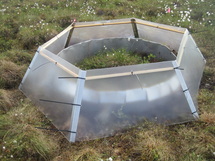
Welcome! We are a research lab at Duke University exploring the causes and consequences of patterns of biological diversity across the planet. We combine observational and experimental approaches with modeling to develop and test hypotheses and build towards synthetic ecological theory. We hope you enjoy exploring our website! You can visit us in person at the Biological Sciences building room 256, 130 Science Drive, Durham NC 27708.
|
NewsApril 2012 Marissa Lee and others publish in Oecologia: Positive feedbacks to growth of and invasive grass through alteration of nitrogen cycle. pdf April 2012 Justin and Jason Fridley publish in Oecologia: Drivers of secondary succession rates across temperate latitudes of the Eastern USA: climate, soils, and species pools. pdf April 2012 Aspen Reese and Cari Ficken have agreed to join the Wright lab to pursue their PhDs. Both will be starting fall of 2012. April 2012 Marissa Lee and Bonnie McGill both receive an Honorable Mention for the NSF GRF proposals March 2012 Amanda Koltz is awarded a DDIG from NSF! Feb 2012 Justin and others publish in Plant and Soil: Different plant traits affect two pathways of riparian nitrogen removal in a restored freshwater wetland Dec 2011 PolarTREC has chosen Amanda Koltz to host a high school environmental science teacher, Nick LaFave from Clover, SC, at the Toolik Field Station, Alaska. PolarTREC is funded by the NSF Office of Polar Programs. Dec 2011 Amanda Koltz received a grant from Conservation, Research and Education Opportunities International (CREOI). Oct 2011 Amanda Koltz is now a Ph.D. candidate! Congratulations on passing your prelims, Amanda! Sept 2011 Justin co-authors a paper with the NutNet group in Science: "Productivity Is a Poor Predictor of Plant Species Richness." Science 23 September 333: 1750-1753 . pdf Sept 2011 Welcome, Steve Anderson! He is a new technician and will be working on the fire regime response and Old Field Succession network projects. Aug 2011 Justin received a 4 year grant from NSF to set up an experimental network along a latitudinal gradient across the Eastern US to determine the relative importance of climate, soils, and evolutionary history in controlling succession in abandoned agricultural fields. Learn more... |